A sleep story · about 41 minutes
The Night of the Extra Hour
Full moon · still · clear · flat sea · cool
The next nights are already out
Season Two comes out early on The Settle Premium, two new nights a week, with all of Season One behind it.
We remind you 3 days before the trial ends. Cancel any time.
How to listen
- Get into bed first.
- Turn the volume down until you can only just follow the words.
- Press play and put the phone face down.
- The story is told twice. The second telling is slower, and nobody is meant to hear the end of it.
The night it's set
Sunday 25 October 2026, the night the clocks go back, so the night is one hour longer than the rest. The air is still and clear, and the moon is full, rising over the hills as the light goes. Every year on this night, the keeper helps the village clockmaker give each clock its hour back.
Season Two follows the real calendar of this coast, from the first cool night of October to the swallows coming back in April. Each story is set on a real Sunday, with that night's moon and weather.
How it begins
The evening is still and clear, and the air has turned cool. Not a breath of wind moves the water in the harbour. Tonight the moon is full, and tonight the clocks go back, so the night will be one hour longer than the rest.
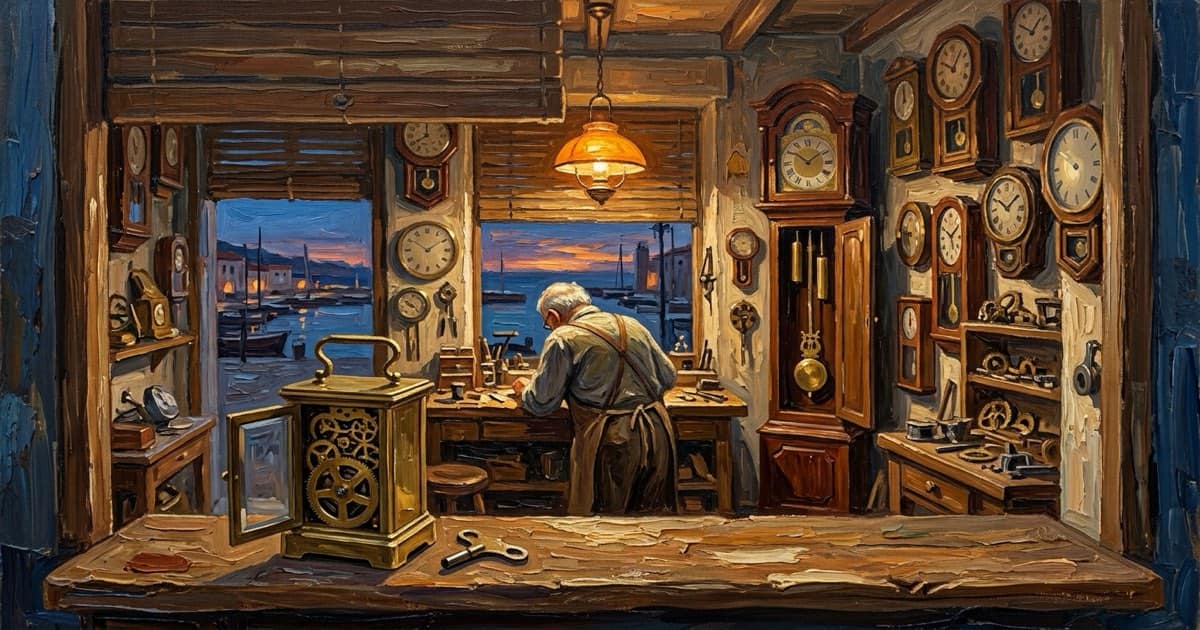
The harbour is quiet at this hour. The boats are in and tied up, their ropes hanging slack. The nets lie folded on the wall. Between two larger buildings stands a small shop with its shutters halfway down, and a painted sign above the door. Tiempo Honesto. Honest Time.
Inside, a single lamp is lit over the workbench, and the ticking is everywhere. Dozens of clocks line the walls, each one keeping time in its own way. Señor Tiempo looks up from the bench, and nods, and goes on with what he is doing. You come every year, on the night the clocks go back. It is slow work, and it goes better with two.
The old clockmaker leaves you the small clocks on the lower shelves. You take the first one down, a plain brass carriage clock, and open the little door at its back. The minute hand goes round under your finger, slowly, all the way, until the hour is given back. Then you close the door, and listen for the tick to settle, and set it in its place again. Then the next.
Next come the clocks on the walls. For each one, Señor Tiempo lifts the glass, and you turn the hand back, gently, and he winds it with its own small key until the spring will take no more. Neither of you says much. There is no need. The work goes round the shop, wall by wall.
The shop smells of clock oil and old wood, and faintly of coffee. The ticking is not one sound but many, fast and slow, near and far, like rain on a roof. Some of the clocks are older than the village lamps. Some came in for mending years ago and were never fetched. They are all wound, and all kept.
The story goes on up the tower and into the night, and then it is told again, slower, for whoever is still awake.